MRRaudit compares Stripe and ChartMogul MRR, showing which customer records and billing events explain mismatches.

When Stripe and ChartMogul report different monthly recurring revenue, the gap can come down to how each system interprets a billing event. MRRaudit is a new tool from ChartMogul that compares the two figures and traces discrepancies to customers, invoices and subscription activity.
The difference matters when a team is using MRR to understand its business. A missed payment, a paused subscription or a discount can change the calculation, depending on the rules applied. Billing systems may count the same event differently, so matching totals isn't simply a matter of checking whether payments arrived.
ChartMogul applies a consistent set of rules to billing data, with settings users can adjust to reflect how their business reports MRR. Those rules may not be the same as the ones used by a billing system such as Stripe. A mismatch, then, can reflect different treatments of the data rather than a missing payment or a simple arithmetic error.
Trace the gap to its source
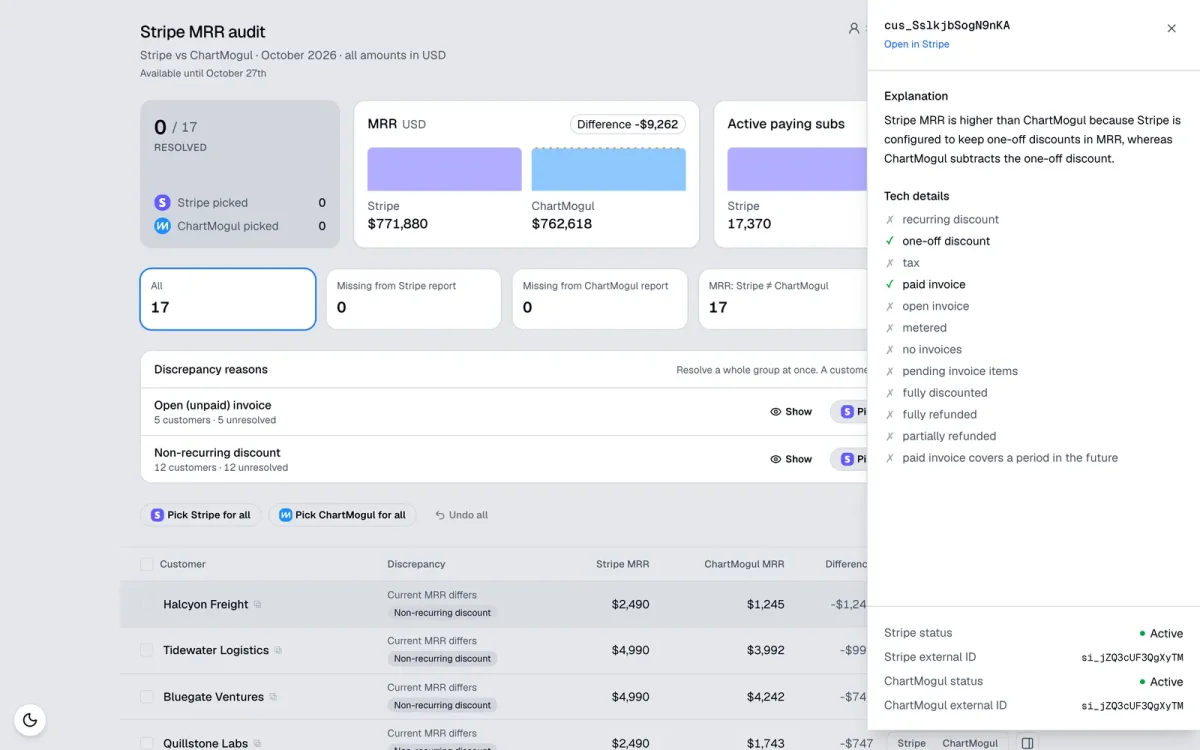
MRRaudit groups discrepancies by cause and connects each one to the records behind it. Users can review missing customers, differences in MRR and subscription status mismatches, with explanations and supporting invoice and subscription details. That makes it possible to inspect how each system arrived at its number instead of relying on a high-level comparison alone.
One example shows why the underlying billing record matters. A customer upgrades to an annual plan priced at $4,800. The team voids the invoice that Stripe generated automatically, then issues a one-time invoice that the customer pays.
Stripe continues to report $400 in MRR from the subscription. ChartMogul reports $0 because it doesn't see a recurring invoice. The customer has paid the annual amount, but the way the payment was recorded changes how the systems calculate recurring revenue. Seeing the invoice and subscription history together helps explain the difference.
The tool also surfaces gaps related to refunds, discounts, failed payments, usage revenue and subscription status. These events can affect MRR in different ways, so a useful comparison needs to show both the amount of the discrepancy and the event that produced it.
Set the rules before reviewing results
To begin, users connect Stripe and ChartMogul. MRRaudit uses read-only access and doesn't change the connected data. A ChartMogul account isn't required to audit Stripe data.
Users then set how their business treats refunds, discounts, failed payments and other events that can affect MRR. Those choices give the comparison a defined basis: without them, a discrepancy may be visible without making clear which treatment fits the business's reporting practices.
After the rules are set, users can investigate the differences, review the supporting records and choose the figure that fits their reporting for an individual customer or a group of discrepancies. The tool is designed to make the reasoning visible, so the decision can be tied to specific billing activity.
That process can be especially useful for companies whose billing history has changed over time. Pricing revisions, customer exceptions and moves from older plans can leave records that don't fit neatly into a current subscription pattern. A mismatch may stem from an invoice error, a timing difference or a billing event that the two systems handle differently. Finding the cause can require looking beyond the latest invoice.
Billing history shapes the number
Lavender's experience illustrates the work involved. When the company's CEO asked for its annual recurring revenue, the team couldn't answer confidently. COO Elliott Fisher said they had to rebuild four years of Stripe invoice history from scratch.
“Our CEO asked a simple question: ‘What’s our ARR?’ None of us could answer with confidence. We had to rebuild four years of Stripe invoice history from scratch. With MRRaudit, we could have found the differences ourselves in a fraction of the time and shown exactly what was behind the number.”
The practical value of an audit is the path it gives a team from a reported total back to the customer activity behind it. That can make recurring revenue figures easier to explain internally and help teams spot where their reporting rules need attention. The next step for anyone investigating a mismatch is to examine the events behind the affected accounts, then decide how those events should count under the business's own MRR rules.
You can get started without perfect data or a ChartMogul account. Start your MRR audit →