Many founders misunderstand the value of visibility, mistaking secrecy for strategy. Building a public presence could unlock crucial opportunities.

Understanding Stealth vs. Visibility
In the startup ecosystem, many founders gravitate towards stealth mode, believing that keeping their projects under wraps provides a strategic advantage. However, this mindset can lead to missed opportunities—both for networking and for future funding. Over my twenty years of active investing, I've noticed two main types of founders leaving potential benefits untapped. The first type willingly engages in stealth, not revealing much about their projects, while the second type seemingly lacks any public presence at all. Both approaches can be detrimental to a founder's credibility and visibility.

The Risks of Being Secretive
Being openly in stealth mode—like saying "I'm working on something exciting" without further elaboration—can create a fog of curiosity, but it leaves much to be desired. For instance, even a simple statement like "I'm focused on innovating in the logistics industry" could spark interest and open networking doors. This allows founders to be discovered by potential investors using tools that aggregate backgrounds and professional signals. When founders make their expertise known, they become part of the conversation, inviting potential customers and partners to reach out to them.
The Dangers of No Presence at All
The far more serious issue arises with founders whose online profiles indicate they're completely disconnected from their work. A generic Gmail address and a sparsely populated LinkedIn page can signal to investors that the founder may not be serious or engaged. Such minimal online visibility raises questions about the founder's commitment and expertise. An application from someone who’s been grinding away on their startup for months can appear identical to that of someone with only a passing idea—unless they present their progress clearly.
Creating a Recognizable Online Identity
Addressing this doesn’t require revealing sensitive product information. Founders can establish credibility by developing a recognizable online identity, which can be as simple as acquiring a custom domain email. For just a few dollars, a professional email can set a serious tone. Even if the domain doesn’t immediately match the brand name, using a name that hints at the work underway—such as travelphds.ai for an AI-driven travel platform—communicates an ongoing commitment to the project.
If brand development is still in the early stages, founders may consider using their own names for a personal domain, which communicates authenticity and accountability. A small blog or profile on this domain can serve as a canvas for sharing insights and the journey, suggesting they've been in the trenches for a considerable time.
Visibility without Self-Promotion
It's crucial to differentiate between visibility and self-promotion. Many founders recoil at the idea of self-promotion, fearing it trivializes their work. However, simply stating the facts—like showing a history of work on LinkedIn—isn't self-promotion; it’s honest representation. A blank profile distorts the reality, making hard-earned accomplishments fade into obscurity.
Instead of aggressively marketing themselves, founders can embody a public student role. For example, someone creating a co-op management tool could share their experiences on co-op boards, ask questions, and engage with others on similar journeys. This low-risk visibility helps clarify their identity within the industry while maintaining curiosity about what they are building.
The Importance of Being Found
When considering opportunities like networking events or venture capital dinners, having a minimal public presence limits access. For instance, during events like Tech Week in New York, where competition is high and applications overwhelm the decision-makers, reviewers often scan profiles quickly. An ordinary Gmail or a blank profile can lead to missed connections that might have otherwise propelled a startup forward.
The asymmetry here is striking: the consequences of a minimal online presence can quietly compound over time. While it may not seem critical initially—like not being able to raise a Series A—this lack of visibility leads to missed introductions and networking opportunities that could positively transform a startup's trajectory.
Making Stealth Work for You
For founders who may feel the need for some stealth, it's essential to recognize the difference between stealth and being invisible. Just because you aren't publicizing every detail doesn't mean you should obscure your presence entirely. If there’s been work put into a project for several months, that effort deserves to be acknowledged publicly—even in subtle ways.
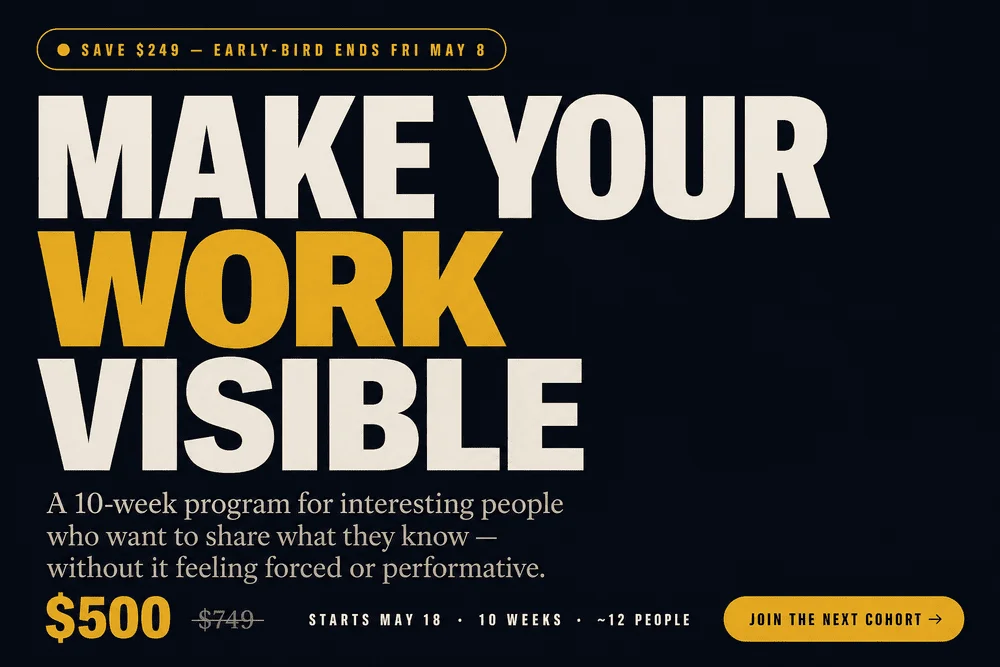
For those starting their journey, there are resources available, like Visible Work, designed to help early-stage founders navigate how to build a public-facing profile that genuinely reflects their efforts without falling into the trap of self-aggrandizement. The next cohort for that program starts soon, and it could provide valuable insights.
Final Thoughts on Visibility
In summary, the downside of invisibility is significant. Founders should strive for a balance; they don't need to reveal everything about their work but should have enough of a presence to ensure their efforts are recognized and valued in their respective industries. A modest investment in establishing an online presence can create ripple effects, unlocking doors to opportunities that might seem unreachable at first glance. Don't underestimate the importance of visibility—it could mean the difference between success and obscurity down the line.


