AI can help buyers compare costs, spot risks and get broader support through a property transaction, while real estate’s built-in borrowing magnifies gains and losses.

Real estate decisions can shape a household’s finances for years, yet buyers often have to weigh a property, a loan and a major life change at the same time. Personal AI could help them organize that work and ask better questions, especially when a realtor’s expertise doesn’t cover every part of a deal. It can’t remove the risk of buying at the wrong time, and borrowing makes that risk matter more.

That combination may be especially familiar to Gen X households. Some are considering a smaller home as children leave; others are helping older parents move into a new stage of life. A Pew Research figure cited in the source says 54% of Americans in their 40s have a parent aged 65 or older while raising or supporting a child. Those overlapping responsibilities can make a property decision harder to treat as a simple search for a house.
Good outcomes don’t prove good judgment
Pirate Eddie and his wife bought a newly built rental home on Hawaii’s Big Island. They secured favorable mortgage terms during the low interest rate period from 2019 to 2021, and hired Shiwota Resorts to manage the property. Its value has more than doubled, according to the account, while the couple also received rental income and personal use of the home.
That result looks like a win, but the owners describe it as luck rather than proof of a repeatable method. Real estate prices and borrowing terms can shift between a purchase and a sale, leaving buyers exposed even when they improve the property or choose a home that initially appears affordable.

A family known to the authors experienced that downside. They sold a home after nearly a decade for less than they had paid, despite making substantial upgrades. They then moved to another city and bought a property whose falling price looked like an opportunity. It later sold for about 25% less than its purchase price, after taking nearly two years to sell. The account estimates the sequence produced a negative $800,000 swing in net worth. In hindsight, it says, waiting a few years could have meant selling the first home for 50% more and buying the second for 30% less.
Those counterfactuals can’t tell a buyer what will happen next. They do show why the full transaction matters: purchase price, sale timing, financing and the time needed to find a buyer all affect the outcome.
Borrowing amplifies both sides
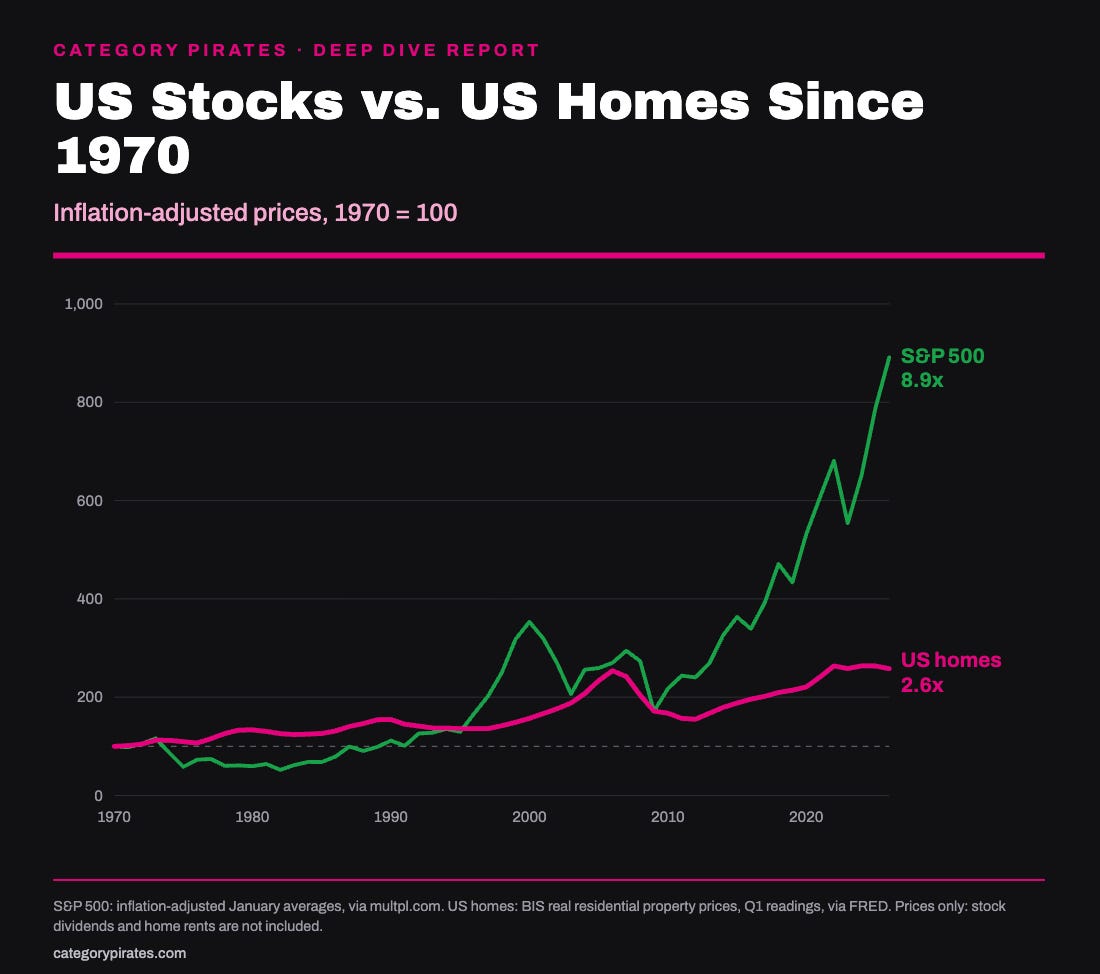
For the median U.S. household, real estate represents half to two-thirds of net worth, the source says. That concentration can make home ownership feel like an obvious path to wealth, though it doesn’t guarantee a strong return. The article’s comparison says stocks lagged real estate from the 1970s through the 1990s, while the S&P 500 outperformed real estate after 2010.

Borrowing helps explain real estate’s appeal: buyers can control a valuable asset without paying its full price upfront. It also makes the result more sensitive to changes in the property’s value. The source reports that 74% of buyers use a mortgage and that the median down payment is 19%. On that basis, a buyer borrows roughly four dollars for each dollar put down.
The comparison offered is Leopold Aschenbrenner, a hedge fund manager who reportedly borrowed three dollars for every dollar invested. After his AI stocks fell more than 30% in July 2026, banks issued margin calls, forcing the sale of a public stock portfolio worth about $16 billion to Ken Griffin’s Citadel. The fund then shrank to about $10 billion. That example concerns a different kind of borrowing, but it makes the general point about leverage: it can magnify results when prices rise and intensify losses when they fall.
A mortgage differs in a practical way. A drop in a home’s estimated value doesn’t by itself trigger a demand from the lender to sell the house. Owners can still face the financial consequences of a poor purchase or an unfavorable sale, however. The useful takeaway is to treat timing and borrowing as part of the decision, rather than assuming a home will appreciate simply because it is real estate.
Where AI might help a buyer
The source identifies three gaps that personal AI could help address. The first is the difference between a realtor’s fee and the service a buyer receives. It describes realtor compensation as 5% of a home’s value, split between the buyer’s and seller’s realtors: $15,000 on a $300,000 home and $50,000 on a $1 million home. The work behind that compensation, it argues, can vary widely.
Some realtors manage the transaction and help clients think through financing, taxes or the life change behind a move. Others may provide less support or focus on closing the sale. AI could give a buyer a way to organize questions and compare explanations, helping make the service received more visible. The figures and fee arrangement here reflect the source’s account; actual compensation can vary.
The second gap is the range of skills a complicated transaction can call for. A buyer may need to weigh property condition, financing, accounting, taxes, negotiation and project management, alongside the personal demands of moving. One realtor is unlikely to be an expert across all those areas. AI tools may help a buyer prepare for conversations with different specialists and keep information together, while leaving professional judgments to the people qualified to make them.
The third gap is uneven use of technology among real estate professionals. Pirate Eddie says he has worked with experienced realtors who were less comfortable with newer tools. For buyers, that can mean doing more of the research and coordination themselves. A personal AI setup could help fill organizational gaps, but its value depends on whether the buyer can check its output and act on reliable information.
The practical case for AI here is preparation: gather the moving parts, test assumptions and arrive at conversations with sharper questions. That won’t predict the market or erase the risks of a mortgage. It may help buyers see the whole transaction before they commit.