Thomas Parrott built demand by centering his work on contribution margin. His story shows why a mini-book needs a precise point of view rooted in lived experience.
A distinctive point of view can change what clients hire you to do. Thomas Parrott learned that when he stopped presenting himself as a guide to US companies entering the UK and Europe and began challenging how those companies measured growth. His focus on contribution margin helped him build a business that prospects sought out for leadership, not just consulting.
Parrott had been a senior executive at Beachbody before joining the third cohort of the Category Design Academy. At first, he thought his business would help American companies expand into Britain and Europe. That direction fit his career and seemed like the obvious next step. But about two thirds of the way through the program, he went back to the early exercises and reconsidered what he was best equipped to address.
He identified contribution margin as his distinctive expertise. Gross margin measures what remains after the direct cost of making a product. Contribution margin goes further, accounting for the additional costs tied to each sale, such as shipping, selling, fees and returns. A business can report growing revenue and healthy gross margin while the incremental costs of winning and fulfilling sales drain cash.
From frustration to a clear market position
Parrott’s insight emerged through an angry, candid discussion in a cohort session. He criticized companies expanding from the US into Europe for relying too heavily on return on ad spend and other measures that, in his view, obscured whether the business was making money. He described firms that grew sales and gross margin but discovered too late that they were losing cash.

The shift in his tone mattered. The polished executive gave way to someone speaking from accumulated frustration and experience. His colleagues recognized that this intensity was part of what made his perspective memorable. The practical lesson for experts writing a mini-book is to notice where strong feelings point to a problem they understand unusually well. A compelling argument often starts with a pattern the writer has seen repeatedly and can explain with specific experience.
Parrott relaunched his business around that argument. When prospects asked him to help plan a UK or European expansion, he told them that entering those markets might be a poor decision if the economics did not work. Some were surprised that he would discourage a project that could bring him consulting revenue. But the candor helped distinguish him from advisers who would simply take the assignment.
The founders call this approach the “no-sell-sell”: being direct about whether a client’s proposed plan makes sense. As Parrott turned down work that did not fit his view, prospects increasingly wanted him involved as a fractional CEO of their ventures. Large companies also brought him in to address new businesses that were growing revenue while burning cash. His client pipeline eventually stretched 18 months, giving him room to choose which engagements to accept.

That result came from a particular combination: a sharply defined problem, executive and advisory experience, a record of results, and a willingness to state an unwelcome conclusion. Other people may understand contribution margin, but Parrott’s history and delivery made the subject his own. For business owners, the broader point is that expertise becomes easier to recognize when it is attached to a specific problem and supported by evidence from work already done.
A mini-book needs the writer’s fingerprints
The authors use Parrott’s experience to make a case for mini-books grounded in lived work. Their ideal book would combine a firm point of view, a framework that helps readers interpret past outcomes and anticipate future ones, and concrete accounts of both successes and failures. The aim is not an accounting primer or a collection of anecdotes without practical use. It is a focused argument that gives readers a way to act or think differently.
That argument should sound like its writer. The authors call this a writing fingerprint: the distinctive mix of ideas, word choices, rhythm, stories and judgments that makes someone recognizable. A writer does not need to invent every underlying concept. They can build intellectual work by connecting existing ideas to outcomes they have driven, lessons they have earned and experiences that shaped their view.
Style, in this account, is part of the value. The authors point to Christopher Lochhead’s fondness for words and phrases such as “legendary” and “don’t be so smart you’re stupid.” Those expressions were not inventions, but their repeated use became associated with his voice. The practical takeaway is to identify language that feels natural and meaningful to you, then use it with purpose. A voice polished into generic professionalism can lose the details that make the underlying expertise memorable.
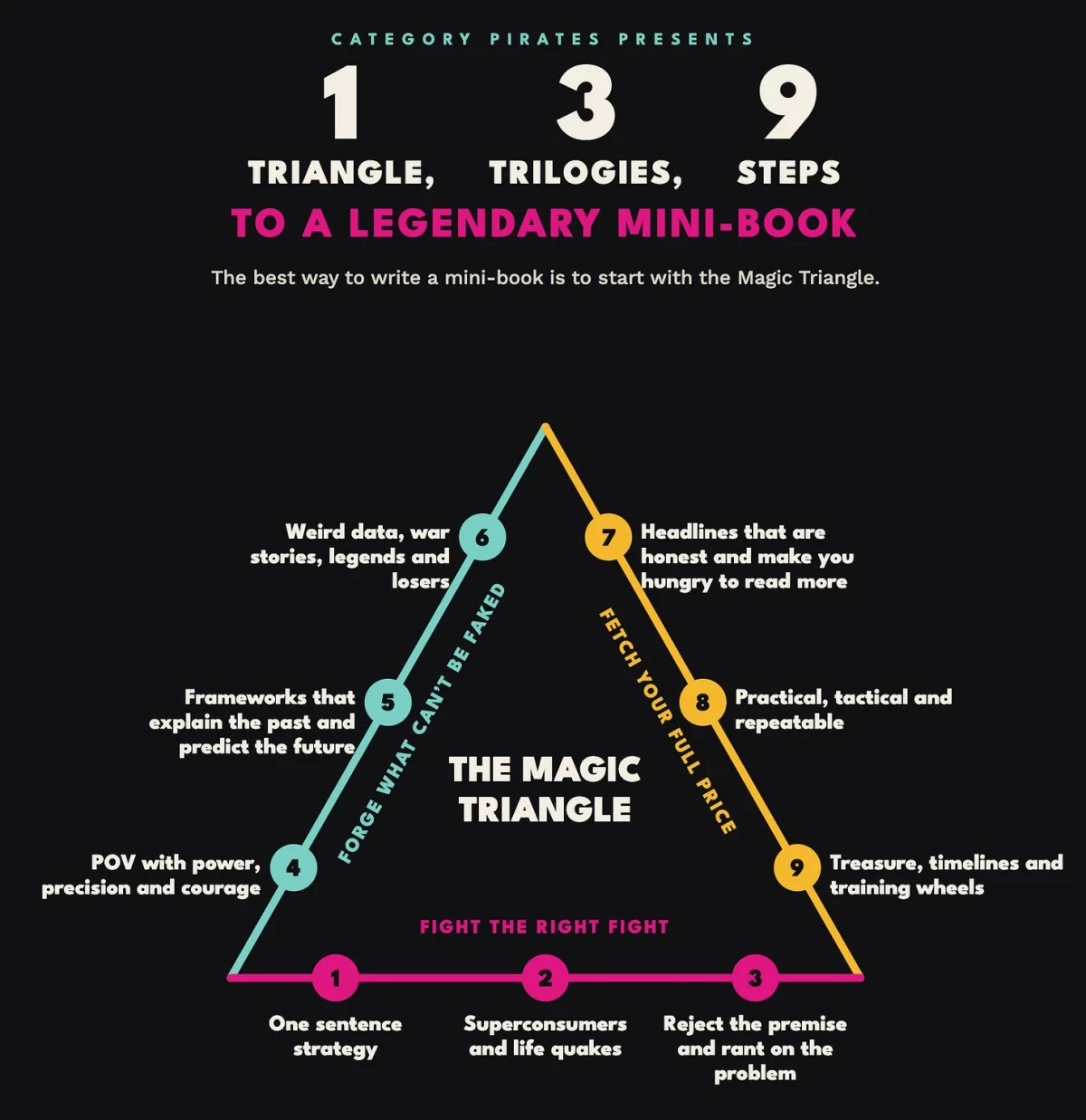
Distinctive writing can also draw on numbers, models and unusual stories. The authors cite their own frameworks, including the Magic Triangle, the Content Pyramid and eight category levers of differentiation, as well as figures they use to describe category performance. They pair those tools with stories from Silicon Valley and large companies. The point is not to copy their mix of serious analysis and humor. It is to build a combination that reflects your own career and experience.
Use AI without losing the author’s voice
The authors describe building a Model Context Protocol server that connects an AI system to a library of their mini-books, journals, reports and session transcripts. They compare MCP to a USB port for intellectual work: the system can search and use material while the owner controls access to the library. Their example raises a useful operational question for anyone applying AI to writing: how can a tool draw on a body of work without flattening the person behind it?
The answer, in their view, is to keep the author’s defining details visible. AI or a ghostwriter may help produce a draft, but the writer still needs to preserve the experiences, opinions and language that distinguish the work. The authors share a story about Michelangelo removing everything that was not David from the statue. Whether or not the story is historically accurate, it captures their advice: editing should clarify the writer’s identity, not sand it away.
Step four: make the point of view strong and specific
Their mini-book process begins with a “Magic Triangle,” with its first three steps covered in an earlier installment. Step four is to develop a point of view with power, precision and courage. A vague argument that changes with the prevailing mood gives readers little reason to keep reading. Strong grammar alone cannot rescue a book that offers no fresh way to understand a real problem.
A useful point of view names a problem precisely, explains why familiar approaches fall short and gives readers a reason to reconsider their assumptions. It should be grounded enough to guide decisions, yet bold enough to be distinguishable from advice anyone might offer. Parrott’s argument about contribution margin worked because it linked a measurable business issue to costly choices companies were making, and because he could support the claim with years of experience.
For an expert planning a short book, the work begins before drafting: decide who has the problem, what the common explanation misses and what your experience lets you say with authority. Then keep the stories, frameworks and language that make the argument yours. A mini-book can help turn expertise into a clearer market position when readers can recognize both the problem it addresses and the person who has earned the right to address it.