Ads inside AI conversations can reach customers near a decision. Founders should scrutinize labels, data use, user controls and more than clicks.
When an ad appears inside an AI conversation, the customer has already shared a question and is considering what to do next. That can make the placement relevant. It also raises the stakes for the businesses that pay to appear there: customers need to know when a message is sponsored and what information shaped its appearance.

OpenAI began testing ads in ChatGPT in the United States on February 9. On May 20, Google described new advertising formats for AI Mode and Search. Both developments bring paid messages closer to the exchanges where people explore products and weigh choices. For founders, the practical question is whether a placement can attract attention while keeping the commercial relationship clear.
Ads Have Entered the Decision Process
Traditional ad formats give people familiar visual cues. A banner sits apart from the page’s main material, while a sponsored search result is presented as a paid listing. In a conversational interface, those boundaries can feel less settled. The system has already heard the customer’s need, and an ad may appear alongside material that feels like guidance.
That proximity is the appeal. A customer asking about a particular product category may find a related paid message useful. Yet relevance alone doesn’t tell the customer who paid for the placement, what information helped select it, or whether it influenced the answer. Clear presentation has to carry more of that burden.
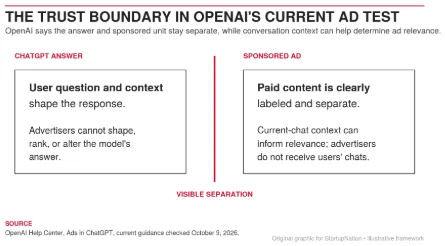
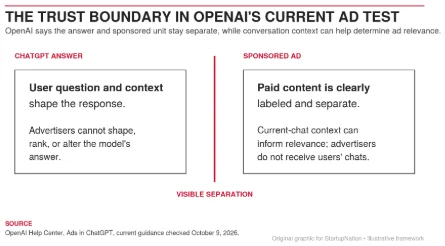
OpenAI’s ad guidance says the current conversation’s context and intent can help determine which ad is relevant. If personalization is enabled, selected information from past chats and memory may also contribute. The company describes ads as labeled units placed below the end of a ChatGPT response, separate from the answer itself. It says advertisers cannot shape, rank or change the model’s response.
Google’s May 20 description of its formats included Conversational Discovery ads, which can answer specific product questions, and Highlighted Answers, which may appear within AI Mode recommendations. Google said the formats remain labeled and may include an AI explainer that is independent of the advertiser’s creative.
The formats differ in where sponsored material may appear. OpenAI describes an ad below a response; Google’s examples include placements within recommendations. For a small business evaluating either option, the key detail is what a customer sees at the moment the paid content appears. A disclosure should be visible without requiring a customer to follow a help link or inspect fine print.
The source material describes Google’s label as “Sponsored,” but its rendering is missing from the provided text. That leaves a useful question for any advertiser to check directly in the product: how prominent is the label on the screen, and does it remain clear as the customer reads and acts?
The Brand Shares Responsibility for Clarity
The platform controls the interface, but the advertiser’s name is still attached to what the customer sees. If a paid recommendation is hard to distinguish from an independent answer, people may blame the business as well as the platform. That can affect whether they keep exploring, click through or trust the next message from the brand.
Clear labeling won’t make every customer welcome advertising in a conversation. It does give them the basic information needed to recognize the commercial relationship. For businesses, that is a practical starting point: the customer should be able to tell who is paying before making a decision based on the placement.
StartupNation has previously written about customer trust as a business driver. In an AI interaction, trust can shape whether the user accepts a recommendation, asks another question or leaves the exchange. That makes presentation part of the customer experience, not a detail to leave entirely to the platform.
Founders should inspect the actual placement rather than rely only on a platform’s general description. Look at it on the screens customers use. Check whether the sponsorship label is easy to notice beside the recommendation and whether the surrounding design could lead someone to mistake the ad for the system’s answer.
Then consider the brand’s own copy. A product description or offer can be accurate and still create confusion if it sounds like a neutral system recommendation. The customer should be able to distinguish the company’s claims from the platform’s response. That distinction matters most when the ad appears near advice or a suggested choice.
Understand the Difference Between Ad Selection and Data Sharing
Personalization can make an ad more relevant, but the process needs a plain-language explanation. For OpenAI’s test, the source says conversation context can help select an ad. With personalization enabled, selected signals from previous conversations and memory may also play a role. That describes information used by the platform to decide which ad to show.

The information advertisers receive is a separate question. OpenAI says advertisers get aggregated performance information, including views and clicks. It says they cannot access users’ conversations, chat history or memories, and do not receive names, email addresses, precise locations or other personal details.
That distinction matters when a business describes a placement to customers or trains its sales team. Saying that advertisers can read a person’s conversation would misstate the arrangement described by OpenAI. So would promising a level of targeting that the platform has not offered. Teams should be able to explain, simply and accurately, what may guide ad selection and what reporting reaches the advertiser.
Data access deserves the same attention across a startup’s other tools. StartupNation has covered data collection by everyday business software, including tool permissions and where collected information goes. The same operational habit applies here: find out what a product uses, what it shares and which controls are available before making claims about it.
Ask the platform team to explain why a particular ad appeared and what information was used to select it. Confirm what the advertiser can see in reporting. Check how a user can hide or report an ad, switch off personalization and learn why that ad was shown. Those answers give the business a more reliable basis for deciding whether the placement fits its customer expectations.
Make sure the people who speak with customers can explain those details without jargon. If the team cannot say what the platform does in plain English, it is not ready to describe the targeting as a selling point. Clear internal understanding also helps prevent marketing copy from making claims the product cannot support.
Measure the Reactions That Don’t Look Like Clicks
A click records an action, not the customer’s full reaction. Someone may click because an ad is relevant, or because its placement resembles a recommendation. Someone else may dismiss an ad without reporting it. A campaign review based only on views and clicks can miss whether people found the placement intrusive or misleading.
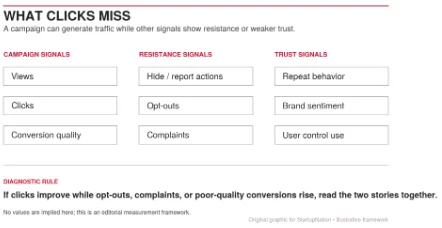
Where the platform provides the information, include hides, reports and personalization opt-outs in the review. Track customer complaints that mention paid recommendations or uncertainty about who produced an answer. Consider conversion quality, repeat behavior and brand sentiment alongside click activity. These signals take more interpretation, but they can reveal whether attention is coming at the expense of confidence.
A public dashboard that tracks ads in AI assistants estimates blocked ad units across supported platforms using anonymous, aggregated filter activity. Its counts are approximate. They indicate one kind of ad avoidance; they don’t establish whether a specific placement converted or whether users object to AI advertising overall.
That limit is important when using outside measures. A blocked ad count is not a customer survey, a conversion report or an explanation of why someone avoided a placement. Treat it as one piece of context and read it alongside the platform’s own performance data and the business’s customer feedback.
Set the review criteria before spending, so the team has a shared way to judge the result. A useful scorecard can combine the available views and clicks with conversion quality, dismissals, reports, opt-outs, complaints and repeat behavior. The measures won’t all carry the same weight in every business, but they make it harder to mistake more attention for a better customer experience.
If clicks rise while conversions weaken, or customer complaints and opt-outs increase, the result deserves a closer look. More traffic alone does not show that the placement is working for the brand. The team should ask whether the message attracted suitable buyers and whether those buyers still felt they understood what they were seeing.
Five Questions to Ask Before Buying a Placement
1. Can customers recognize the ad at a glance?
Inspect the placement in the live interface. Find the sponsorship label before clicking, then look at the recommendation as a customer would. If you need to open a help page or examine small print to recognize a paid message, the disclosure may not be doing enough work.
Check how the label appears on different screen sizes and how it relates visually to the answer around it. The goal is a clear distinction between paid content and the platform’s response. A business should understand that distinction before it puts its name beside the recommendation.
2. What information helps select the ad, and what reaches the advertiser?
Keep those questions separate. In OpenAI’s test, the current conversation can help determine relevance, and personalization may draw on selected signals from past chats and memory. OpenAI says advertisers receive aggregated performance data such as views and clicks, not the conversation itself or identifying personal details.
Make sure privacy explanations and customer-facing descriptions match the platform’s stated arrangement. Avoid implying that the advertiser can inspect private conversations or use information the platform has not made available. Accuracy here is part of the trust the brand is asking customers to extend.
3. What choices does the customer have?
Try the user controls yourself. Find the options to switch personalization off, hide an ad, report it and learn why it appeared. Then consider whether the business can explain those options when a customer asks.
Controls do not guarantee that everyone will be comfortable with advertising. They do show whether people have practical ways to respond to a placement. If the controls are hard to find or unclear, include that in the decision about whether the format suits the brand.
4. What matters besides the click total?
Review conversion quality, complaints, opt-outs, repeat behavior and available hide or report signals. Add brand sentiment where the business already gathers customer feedback. Compare those measures with views and clicks to see whether the placement is bringing interested buyers or simply generating activity.
A rise in clicks may look encouraging, but it is not enough if customers convert less often or become more reluctant to trust the next recommendation. The useful question is whether the placement supports a healthy relationship after the initial interaction.
5. Would the placement seem fair if customers knew how it was selected?
Think from the buyer’s side of the screen. Can the business explain why the ad appeared, what information may have informed it and what the advertiser actually receives? If the explanation would surprise customers, revisit the placement or the claims attached to it.
The source also describes an August 27 action involving the Federal Trade Commission and firms accused by the agency of making false claims about an AI-powered advertising service. The claims said the service could target people using conversations captured from smart devices and that consumers had opted in. According to the agency, the service did not work as described and consumers had not given the claimed consent.
For a business, the practical lesson is to substantiate claims about targeting and consent before using them in customer-facing material. A technical possibility is not proof that a feature works as advertised, and it does not establish that people agreed to its use. Get evidence for the capability and keep records supporting any consent claim.
StartupNation’s discussion of trust in the AI tools a business uses makes a related point: teams need to understand the systems behind their work. That includes checking product claims and accounting for the trade-offs those systems create for customers.
Keep the Customer’s Confidence in the Review
Conversational AI can put a paid message close to the moment when a customer is weighing a choice. That can create a useful opportunity for a business with a relevant offer. It also makes the boundary between advice and sponsorship especially important to the customer experience.
Founders evaluating these formats should check the label, understand the data flow, test the user controls and define success with more than clicks. The final review should ask whether customers can recognize the ad and still trust what they read afterward.
That judgment may not fit neatly into a platform dashboard. It still belongs in the business’s assessment of whether the placement is earning attention in a way customers will accept.
Image by DC Studio on Magnific
The post The Ad Has Moved Into the Conversation. What Does That Mean for Startup Trust? appeared first on StartupNation.