Transform your sales training approach with our comprehensive template focused on measurable behavior change and ongoing accountability.
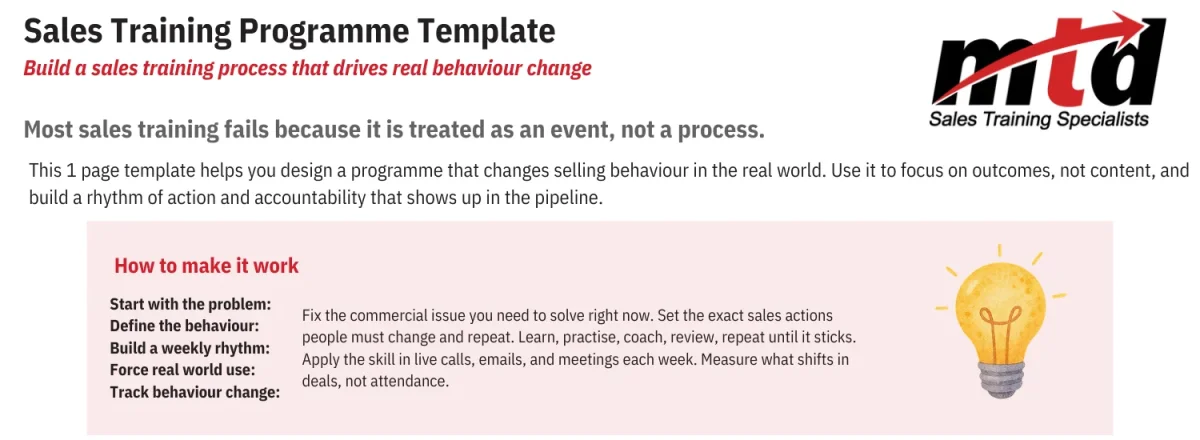
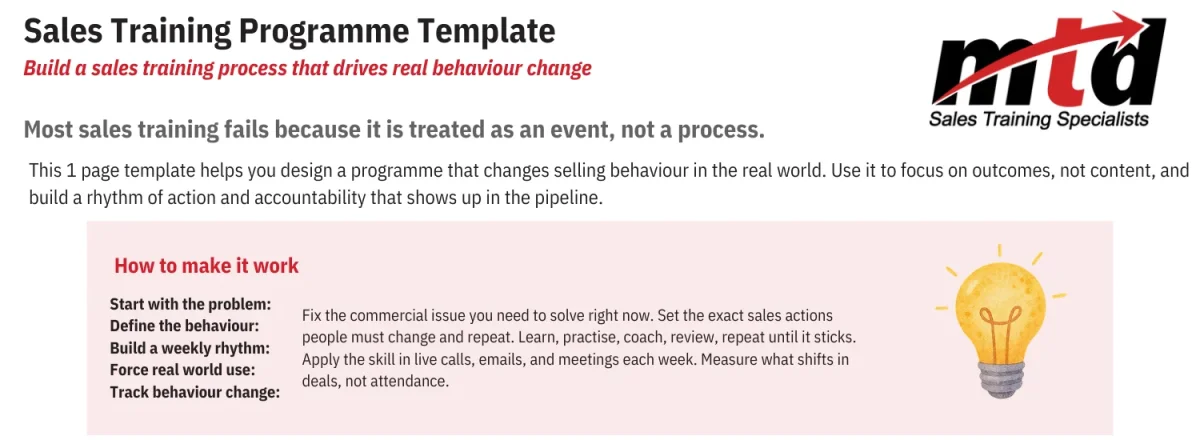
A structured sales training programme can convert learning into consistent results. Instead of treating training as a one-off event, organizations can embed it into their processes, leading to a lasting impact based on behavior change rather than just content consumption.
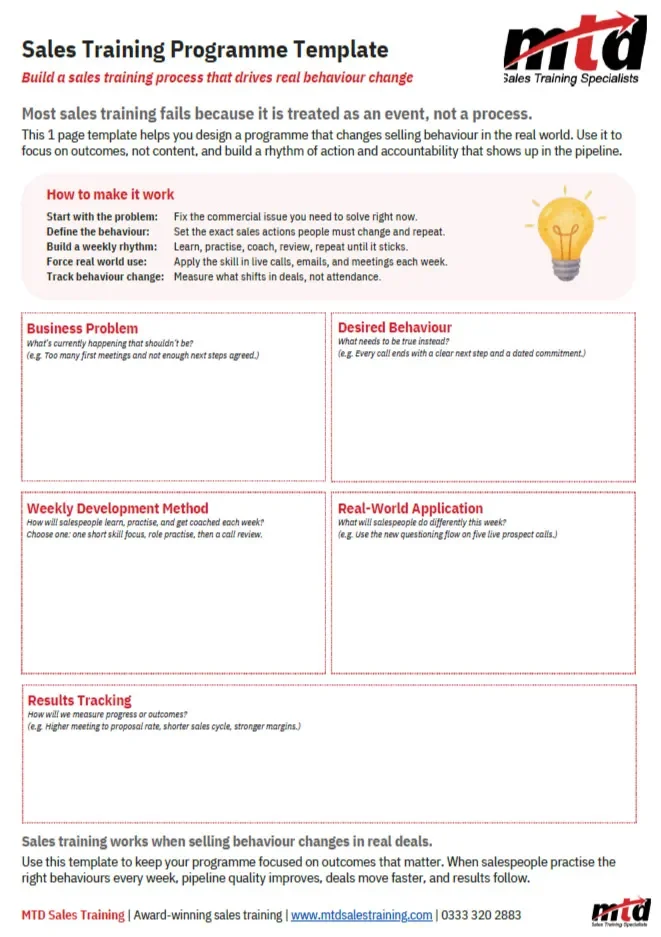
To that end, we’ve designed a 1-page Sales Training Programme Template that serves as a streamlined framework for creating impactful training initiatives that drive measurable improvements in sales performance.
Understanding ROI in Sales Training
Many sales training programs fall short because they are often too reliant on format. A typical scenario involves booking a one-day course to rave reviews, only for behavioral changes to remain nonexistent once back in the workplace. The reality is that if training is treated merely as an isolated event, employees will quickly revert to old habits, ultimately undermining the initial investment.
This phenomenon occurs when businesses overlook the necessity of structure. Genuine improvements arise from consistently applying, reviewing, and reinforcing learned behaviors over time. Absent this consistent structure, the benefits of training dissipate quickly.
Fostering Behavioral Change in Training
Effective sales training must shift behavior back on the job rather than just raising awareness. Sales success is contingent upon the abilities of salespeople to implement techniques in actual conversations, to reflect on their experiences, and to adjust their approaches accordingly.
This is why training must evolve into a well-organized programme. While a single workshop can ignite initial interest, a comprehensive programme nurtures habit formation.
| Low-Cost Training | High-Value Training |
|---|---|
| Workshops | Programmes |
| “We delivered training.” | “Reps now open stronger sales conversations.” |
| Learning happens once. | Learning happens repeatedly. |
| Knowledge increases. | Behaviour changes. |
| No accountability. | Accountability built in. |
The Purpose of the 1-Page Template
This template acts as a blueprint—forging clarity before diving into the detailed design of your sales programme. Too often, training initiatives begin with slide decks and session outlines without addressing the fundamental questions of what specific business challenges need resolution.
With the 1-page format, you can clarify:
- The business issues you’re attempting to resolve.
- The desired new behaviors.
- Your weekly development rhythm.
- Real-life actions sales reps must initiate.
- Success metrics that will be tracked.
Mapping these key areas transforms the training approach from being vague into one that prioritizes tangible performance improvements.
How to Build Your Sales Training Programme: A Step-by-Step Approach
Step 1: Identify the Business Problem
Begin with the fundamentals: What ongoing issues need addressing? For instance, issues may include stalled deals due to weak discovery processes or excessive discounting under pressure.
When you clarify your starting point explicitly, such as noting “Reps are losing deals at the proposal stage due to weak questioning,” the focus remains on purposeful training aimed at change and improvement.
Step 2: Define Desired Behavior Changes
Sales training should prioritize actionable behaviors rather than theoretical knowledge. Consider what observable actions would indicate that the identified problem has been resolved. For example, desired changes might include reps asking at least five discovery questions before pitching or utilizing ROI statements instead of discounting.
Pinpointing these behaviors instills shared understanding among trainers, managers, and sales reps about what successful outcomes look like.
Step 3: Establish a Weekly Development Rhythm
A weekly development framework cultivates momentum and ultimately leads to habit formation. A robust approach could involve:
- Week 1: Live training focused on specific behaviors.
- Week 2: Implementing field application tasks.
- Week 3: Check-in with coaching or accountability calls.
- Week 4: Reflection and adjustment periods.
Instead of an extensive syllabus, aim for concentrated improvement cycles that are manageable and effectively reinforced.
Step 4: Ensure Real-World Application
Salesknowledge is fortified through practice. Every learning session should culminate in concrete challenges that salespeople need to implement, moving away from theoretical concepts.
Examples of practical applications could include tasks like:
- “Use the new questioning framework on your next three discovery calls.”
- “Defend pricing using the provided ROI statement in a negotiation.”
- “Revisit and follow up on a stalled deal using the new sequence we covered.”
This reinforces the learning in real-world scenarios and aids in the transition from knowledge to performance.
Step 5: Track Results, Not Just Attendance
Attendance figures do not translate into changes in sales performance. It's pivotal to connect observed outcomes with business impacts. Focus on proof points that demonstrate real-world effectiveness.
Explore actionable questions such as:
- “What did you apply this week?”
- “What were the actual results of these applications?”
- “How did the new behavior influence sales outcomes?”
Indications like improved conversion rates or reduced discount levels tell a powerful story that resonates with onlookers within the organization.
Example of a 6-Week Sales Training Programme
Here's how your filled-in template might appear in practice:
Business Problem:
Salespeople are using excessive discounts to close deals.
Desired Behavior:
Reps should focus on value selling instead of discounting and defend margins with confidence.
Weekly Development Method:
- Week 1: Live session on value-based selling strategies.
- Week 2: Implement the new pricing framework during customer interactions.
- Week 3: Review outcomes along with line managers.
- Week 4: Team presentations of successful approaches.
- Weeks 5-6: Peer practice sessions to reinforce learning.
Real-World Application:
Reps will draw on value-focused statements in each client engagement.
Results Tracking:
- Average discount reduced by 5% in six weeks.
- Improved close rate by 9%.
- Generated an additional £180k in margin.
This effectively demonstrates the potential to move from concepts to transformations.
Why This Template Excels Where Others Fail
Many sales training initiatives misfire because they are too comfortable, offering motivational experiences that don’t yield tangible results. This template addresses the need for a rigorous framework that enforces clarity, application, and accountability.
It requires organizations to maintain three key elements:
- Clarity in identifying what needs change.
- Immediate real-world application.
- Accountability for executing tasks.
When these competencies align, it facilitates behavioral changes leading to improved performance metrics.
Avoiding Common Pitfalls
Even the most thorough programs can falter due to inadequate setup. Sidestep these frequent errors:
- Launching with subject matters, rather than pinpointing issues.
- Attempting to tackle too many behaviors at once.
- Neglecting reinforcement after initial workshops.
- Excluding managers from the process, as they play a crucial role in sustaining change.
Countless companies claim, “We conducted sales training; however, nothing shifted.” The failure stemmed from a lack of structure—proving that a single-day course may elevate awareness but a program relying on regularity delivers real capabilities.
Post-Programme Actions
Continue the momentum after formal instruction concludes. Reinforcing behavior changes and measurement is crucial to prevent a decline into old patterns.
Encourage the following actions:
- Conduct monthly one-on-ones to examine progress.
- Foster peer accountability through shared progress discussions.
- Visualize results using a shared tracking system for transparency.
Small yet consistent check-ins can foster a supportive environment that continuously drives performance forward.
How to Leverage This Template with Your Team
Feel free to download the template below, and put it to work in developing your sales training programme. Utilize this resource for planning internal training or for collaborating with external partners like MTD.
This will ensure alignment on success measures from the outset before heavy investments in resources or time.
Download link placeholder: [Sales Training Programme Template PDF]
By establishing your foundation with a clearly defined business issue, a desired outcome, and a systematic rhythm for development and evaluation, you lay the groundwork for tangible growth.
Conclusion
Winning sales strategies are less about transmitting knowledge and more about fostering a shift in approach and behavior. This 1-page template emphasizes clarity, actionable steps, and the metrics necessary to confirm its efficacy.
When sales training translates into behavioral change, real results will follow. Consider exploring further resources at MTD Sales Training or reach out at 0333 320 2883 to discuss tailored training solutions.
Happy Selling!
Sean

Sean McPheat
Managing Director
MTD Sales Training

The post Sales Training Programme Template (Free 1-Page Download) appeared first on MTD Sales Training.


