Gusto’s survey finds owners remain upbeat about their firms as costs, hiring challenges and borrowing weigh on plans; 67% use AI tools.
Small business owners are more confident in their own companies than in the broader U.S. economy, even as rising costs and financing pressures shape day to day decisions. In Gusto’s 2026 State of Small Business survey, 61% said they were optimistic about their business, unchanged from a year earlier. Just 18% felt optimistic about the economy, down from 29% in 2025, while the share describing themselves as pessimistic rose to 59%, from 50%.
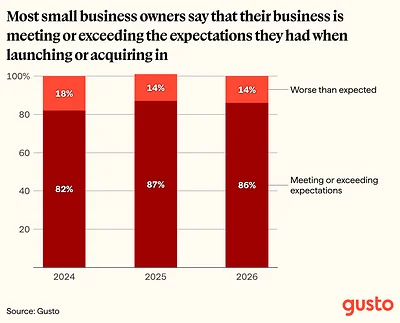
The survey covered 1,731 U.S. small business owners with 24 or fewer employees. Its clearest operating signal is a split between how owners view their own results and how they assess the conditions around them: 86% said their business was meeting or exceeding the expectations they had when they started it, even as concerns about the economy spread across industries and regions.

For owners, that distinction matters. Confidence in a company can rest on what its customers are doing and how well its own operations are performing, while confidence in the wider economy reflects pressures that are harder for any one firm to control. The data suggest many owners still see demand for their products and services, but feel less certain about costs and planning ahead.

Customer demand supports optimism
Pessimism about the economy increased in every industry, rising by an average of 9 percentage points. The change was largest among goods-producing businesses, where pessimism climbed 12 points, and among owners in the West, where it increased 14 points. Those shifts sit alongside the finding that most owners still believe their firms are on track against their original expectations.

Among owners who were optimistic about their businesses, 68% pointed to customer spending and demand as the reason. That makes customer activity a practical watchpoint: confidence appears tied to whether buyers continue to spend. Nich Tremper, Gusto’s senior economist and head of Gusto Insights, said owners also cited higher costs and expensive borrowing as obstacles to planning. He cautioned that a pullback in customer spending could weaken their confidence.

The survey doesn’t establish what any individual firm should expect next. It does show why business owners may hold two views at once: their own company can be performing reasonably well while the economic outlook feels more uncertain. Tracking sales and customer demand alongside expenses can help operators understand which side of that divide is changing inside their own business.
AI use is spreading, with oversight varying by task
AI tools have entered the work of 67% of surveyed small businesses, though adoption ranges from limited trials to broader use. Nineteen percent were experimenting with AI, 28% used it for at least some tasks, 15% applied it regularly across multiple functions, and 5% said it was built into every part of the business where the technology allowed.

Use was most extensive in professional services: 27% of firms in that sector used AI across multiple functions or throughout the business. The comparable figures were 16% for personal services and 13% for community services. The gap suggests adoption is not uniform; the way work is organized and the tasks a firm handles may affect where owners see a fit.

Workplace rules are also becoming more common. A quarter of businesses with employees had an AI policy, up from 15% a year earlier. Owners were more comfortable giving AI limited human review for communications than for data analysis or direct customer questions. About 60% of people already using AI were comfortable with it drafting marketing content under limited oversight, compared with 27% of nonusers.

That divide points to a useful operational distinction: comfort with AI depends partly on the task and partly on experience using the tools. Owners considering where AI fits can start by identifying work that has a clear review step, such as drafting marketing material, and decide who checks the output. The survey records owners’ comfort levels; it doesn’t measure the quality or business impact of AI generated work.

Input costs and interest rates are shaping decisions
Changing input prices hurt 59% of respondents over the prior year, while just 3% said the effect was positive. Goods-producing firms reported particular strain: 26% said price changes had a much more negative effect, compared with 20% of businesses overall. Rising interest rates hurt 40% of owners.

Pricing has been one response. Fifty-two percent of businesses raised prices during the past 12 months, most commonly by up to 10%. Half planned another increase in the coming year. These figures show how widespread price adjustments have become, but they don’t describe how customers responded or whether the changes fully offset higher expenses. Owners face the practical balancing act of protecting margins while keeping prices workable for their customers.

Hiring and borrowing add pressure
Twenty-six percent of owners tried to hire during the year and had trouble finding qualified people they could afford. Among those who struggled, 64% said candidates lacked the skills the role required. The smallest firms more often said qualified candidates’ pay expectations were beyond their budgets; larger small businesses more often encountered scheduling conflicts.
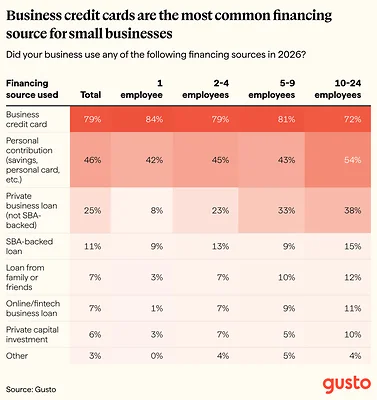
Financing patterns offer another view of the strain. Among firms that used outside financing during the year, 79% used a business credit card, up from 69% in 2025. Of those card users, 63% didn’t pay off the balance each month, suggesting that some were carrying card debt over time. Meanwhile, 35% of all surveyed businesses used no outside financing.
Most owners who sought financing obtained the full amount they wanted: 85% said they secured everything they needed. Results differed by outlook. Nearly nine in 10 optimistic owners got all the financing they sought, compared with nearly three-quarters of pessimistic owners. Tremper said high borrowing costs could persist into 2027 and that owners may keep looking to credit cards or short-term financing as costs stay elevated.
For operators, the survey’s practical takeaway is to watch demand, pricing, hiring costs and financing together. Customer spending is a major source of optimism, while higher expenses and borrowing costs are already affecting decisions. The next signs to follow are whether demand holds up after price increases and whether firms can fund their needs without leaning further on costly credit.